

Train Your Brain Like a Muscle: How Neurofeedback Therapy Is Changing Mental Health and Sleep Treatment
Integrative Care for Concussion / Head Injury Sufferers
in Ft. Lauderdale and Boyton Beach, Florida
Introduction: What If You Could Retrain Your Brain?
When most people think about mental health treatment, two options come to mind: talk therapy and medication. While both play important roles in healthcare, they are not always sufficient—and for many individuals, they come with limitations, including unwanted side effects, long waiting periods, or simply a lack of measurable progress. But what if there was a third option? One that works with your brain’s natural ability to adapt and heal?
Neurofeedback therapy is a clinically-informed, non-invasive approach that is gaining recognition in the mental health and sleep medicine communities. At Radius TBI, we believe in equipping our patients with the most advanced, evidence-based tools available—and neurofeedback is one of the most exciting innovations in personalized brain health today.
What Is Neurofeedback Therapy?
Neurofeedback therapy is a form of biofeedback that measures and responds to your brain’s electrical activity in real time. Using advanced sensor technology, the therapy monitors your brainwave patterns and provides immediate audio or visual feedback that gently guides your brain toward healthier, more balanced activity.
Think of it like physical therapy for your brain. Just as a physical therapist uses targeted exercises to help a patient regain strength and mobility after an injury, neurofeedback uses real-time data and feedback loops to train the brain to function more efficiently. Over time, this process can help the brain shift away from patterns associated with dysfunction and toward patterns associated with calm, focus, and resilience.
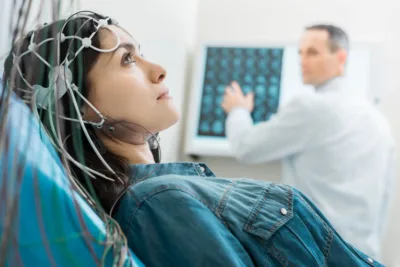
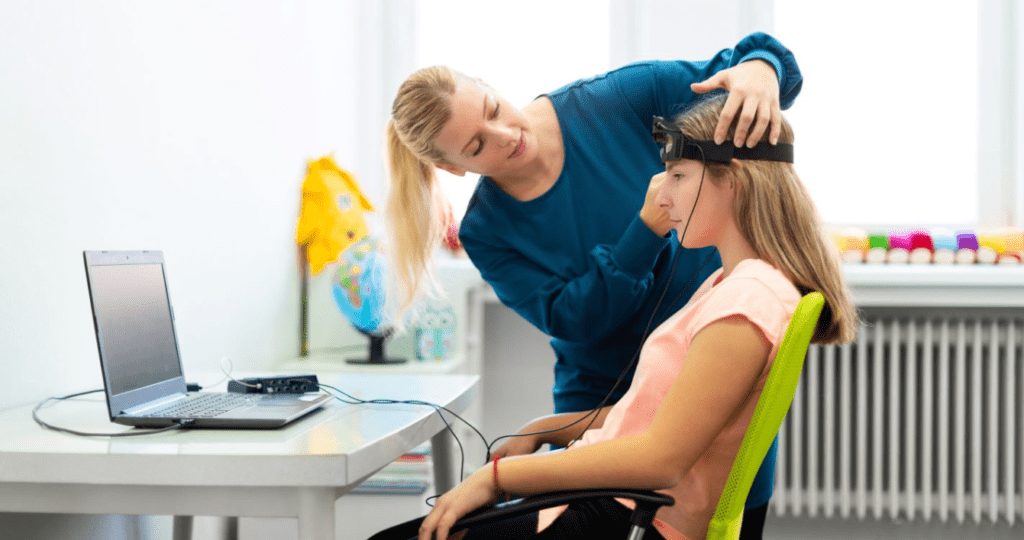
The process is non-invasive and drug-free. Sensors are placed on the scalp to detect brainwave activity. The patient then watches a screen or listens to audio cues. When the brain produces a desired pattern, the feedback is positive—encouraging the brain to repeat that pattern. When the brain strays from the target, the feedback shifts, gently prompting a correction. With repeated sessions, these new patterns become more stable and automatic.
Who Can Benefit from Neurofeedback?
Neurofeedback therapy has shown promising results in addressing a wide range of conditions related to brain dysregulation. At Radius TBI, we use neurofeedback to help patients who may be experiencing symptoms associated with:
- Sleep issues and insomnia
- Anxiety and chronic stress
- Brain fog and cognitive difficulties
- Depression and mood instability
- Memory challenges
- Attention and focus difficulties
- Trauma-related nervous system dysregulation
It is important to note that neurofeedback is not a cure-all, and results vary by individual. However, for many patients who have not found adequate relief through conventional treatments alone, neurofeedback can be a meaningful addition to their overall care plan.
The Science Behind Brainwave Training
Your brain operates on electrical impulses that create recognizable wave patterns. These patterns—categorized as delta, theta, alpha, beta, and gamma waves—correspond to different states of mental activity. For example:
- Delta waves are associated with deep, restorative sleep
- Theta waves are linked to light sleep, creativity, and deep relaxation
- Alpha waves reflect a calm, alert mental state
- Beta waves are associated with active thinking and focus
- Gamma waves are connected to higher cognitive processing
When these brainwave patterns fall out of balance—due to stress, trauma, neurological conditions, or other factors—a person may begin to experience symptoms. Someone with chronic sleep difficulties, for instance, may show elevated beta activity at night when the brain should be winding down into delta or theta. Someone with depression might show patterns of underactivity in regions associated with motivation and reward.
Neurofeedback works by identifying these imbalances through a process called brain mapping (or a quantitative EEG), and then designing a personalized training protocol to address them.
The Radius TBI Approach: Starting With Your Brain Map
At Radius TBI, we do not believe in one-size-fits-all treatment. Every brain is unique, and effective neurofeedback therapy must begin with a thorough understanding of your individual brain’s activity.
That is why we start every neurofeedback program with a custom brain map. This painless, non-invasive assessment records your brainwave activity across multiple regions of the brain and compares it against established normative databases. The result is a detailed picture of how your brain is functioning—and where it may benefit from support.
Based on your brain map results, our clinical team develops a personalized neurofeedback protocol tailored to your specific patterns, symptoms, and goals. This individualized approach ensures that your training is targeted, efficient, and aligned with your unique neurology.
Throughout the process, we continue to monitor your progress and adjust your protocol as your brain responds and improves. Neurofeedback is not a passive treatment—it is an active collaboration between our clinical team and your brain’s own capacity for change.
Neurofeedback vs. Medication: Understanding Your Options
One of the most frequently asked questions we receive at Radius TBI is how neurofeedback compares to medication for conditions like anxiety, depression, and sleep disorders.
Medication can be a valuable and sometimes necessary component of mental health treatment. However, it is not without drawbacks. Many patients experience side effects ranging from mild to severe. Others find that medications address symptoms without addressing underlying brain dysregulation. And for some, the prospect of long-term pharmaceutical dependence is a concern.
Neurofeedback offers a complementary or alternative path that works directly with the brain’s neurological patterns rather than altering brain chemistry through pharmaceutical means. It is not sedating, does not carry the same risk of dependency, and does not produce the systemic side effects commonly associated with psychotropic medications.
It is worth emphasizing that neurofeedback is not a replacement for medication in all cases. For some patients, a combination approach—incorporating neurofeedback alongside other therapies or medications—may be the most effective path forward. Our team at Radius TBI is committed to helping each patient navigate these decisions with clarity and evidence-based guidance.
What to Expect During a Neurofeedback Session
Many new patients are curious—and sometimes apprehensive—about what a neurofeedback session actually involves. The good news is that it is a comfortable, relaxing experience for most people.
During a typical session, you will sit in a comfortable chair while small sensors are placed on specific areas of your scalp. These sensors are not delivering any electrical current—they are simply reading your brain’s naturally occurring electrical activity. You will then watch a screen or listen to audio, while the neurofeedback software monitors your brainwaves and provides real-time feedback.
Sessions typically last between 30 and 60 minutes. Many patients report feeling calm and mentally clear after sessions. Some notice gradual improvements in sleep quality, focus, or mood over the course of several weeks of regular training.
Most neurofeedback programs involve multiple sessions over a period of weeks or months, as meaningful brain change typically occurs through repetition and consistency—much like building any new skill.
Is Neurofeedback Right for You?
Neurofeedback is not appropriate for every individual, and candidacy should always be assessed by a qualified clinician. That said, it is a well-tolerated option for a broad range of patients and has a strong safety profile.
At Radius TBI, we encourage anyone who is curious about neurofeedback to reach out for a consultation. Our clinical team will review your health history, discuss your symptoms and goals, and help you determine whether neurofeedback—and which protocol—may be the right fit for your needs.
Ready to explore a new approach to brain health? At Radius TBI, we start with a custom brain map and build a personalized plan around your unique needs and goals. Contact us today to schedule your consultation and take the first step toward a healthier, more balanced brain.
DID YOU KNOW?
TBI is a major cause of death and life-long disability in the United States. (including all levels of severity)
- An estimated 1.5 million Americans sustain a TBI (Sosin, Sniezek and Thurman 1996);
- 50,000 die from these injuries; and 80,000 to 90,000 experience onset of long-term disability (CDC 1999).
- An estimated 5.3 million Americans live with a permanent TBI-related disability today (CDC 1999).
According to the report to Congress on mild traumatic brain injury in the United States. Centers for Disease Control and Prevention; 2003. https://www.cdc.gov/traumaticbraininjury
Blogs

Exploring Brain Injury: Get Help From Our Rehabilitation Program
Expert Diagnosis & Treatment of Brain Injury at Radius TBI Medical Center in Broward County & Pinellas County, FL. Gets the Help You Deserve!

14 Eye Symptoms & Eye Problems After Car Accidents/TBI
Beyond the Surface: The Hidden Toll of Eye Problems After Car Accidents. Learn about eye problems after car accidents and traumatic brain injury risks. Protecting your eye and vision with Radius TBI in Ft. Lauderdale, FL.

Dr. Eric F. Ciliberti: Our Best Neuro-ophthalmologist in Broward, County Location
Optimizing Visual Health: Meet Top Neuro-Ophthalmologist in Broward. Discover how Dr. Ciliberti enhances visual health at Radius TBI in Florida.

A Deep Dive into Electromyography (EMG Test): Decoding the Language of Muscles and Nerves
Electromyography (EMG) is a diagnostic procedure that plays a crucial role in unraveling the intricacies of the neuromuscular system. By measuring the electrical activity within muscles and the nerves controlling them, EMG provides valuable insights for the diagnosis and management

Meet our best Psychologists in Broward County, FL Location
This blog will highlight a group of exceptional psychologists – Dr. Ann Marie Paolino, Dr. Beatriz Amador, and Dr. Esther L. Misdraji – who specialize in helping TBI patients recover their lives. These dedicated professionals know the significance of psychological

Why See Neuropsychologist After Head Injury?
A head injury can be a devastating event that can have long-lasting effects on a person’s life. Depending on the severity of the injury, a person may experience a range of physical, cognitive, and emotional symptoms that can significantly impact

Are you struggling with dizziness, vertigo, or unexplained balance issues?
Videonystagmography (VNG) is a diagnostic procedure that assesses the performance of the vestibular system, the brain and the inner ear, which is essential for maintaining balance and spatial orientation. Often used to distinguish between central and peripheral causes of dizzy

After Car Accident, Let Us Help You Recover from Head Injury
Radius TBI’s Life-Changing Medical Expert Team for Injured Victims After Car Accident. How do you know you have TBI? We can test you. Call Us!